Tuesday, September 1, 2015

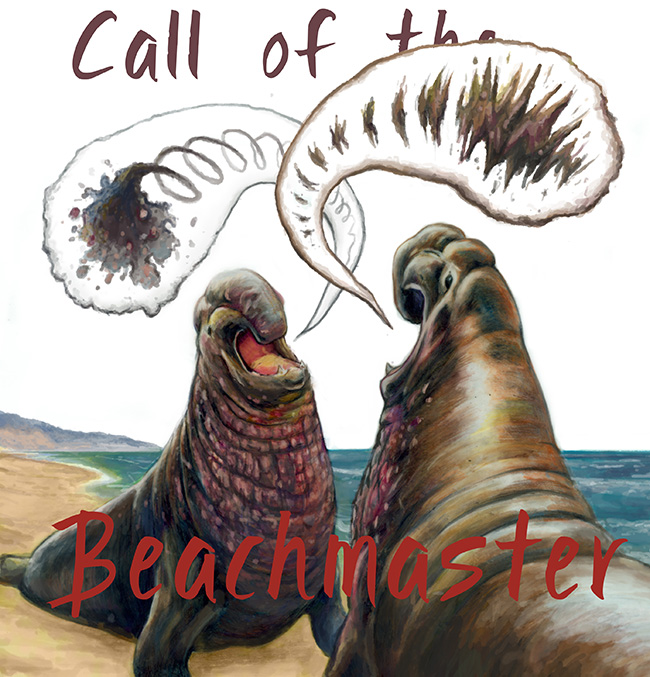
Call of the Beachmaster

UC Santa Cruz science-communication student Nala Rogers put together a great summary of the work being conducted by the Reichmuth lab, part of the dissertation of Caroline Casey.  Follow the link below for an in-depth description of the research that is beautifully illustrated.

http://sciencenotes.ucsc.edu/2015/pages/seals/seals.html

seals feature art

Monday, August 24, 2015

Brandt's Cormorants raised at Ano Nuevo Island

The Brandt's cormorants at Ano Nuevo Island have spent the past
few months rearing chicks and they will soon fledge.  Here is a video
taken by Pat Morris on August 18th, 2015 showing how the adults
feed the chicks:


Thursday, August 13, 2015

New research on the role of vocal cues in elephant seals!

New research by UC Santa Cruz Researcher Colleen Reichmuth and graduate student Caroline Casey give us a glimpse into the acoustic world of male elephant seals!  Their work is an extension of a project done by Burney LeBoeuf many years ago when the Ano Nuevo elephant seal colony was quite young.

CLICK HERE for a detailed description of their recently published findings.


Saturday, June 6, 2015

Real time elephant seal tracking!

This is an exciting time for Dan Costa's team at UC Santa Cruz.
Satellite tags and time-depth recorders are being attached to
elephant seals at Ano Nuevo AND San Nicolas Island.  Please
follow this link to see the latest data and track these seals in real
time over the next 8 months!

http://www.seaturtle.org/tracking/?project_id=1100


Thursday, April 30, 2015

Elephant Seal Research on TV!

Jeff Corwin filmed an entire episode of his show "Ocean Mysteries" at Ano Nuevo.  This episode, focused on UCSC Professor Dan Costa's elephant seal research program, will air on Saturday May 1st on ABC.  It will also (eventually) be available on-demand at Hulu.com:  http://www.hulu.com/ocean-mysteries
Be sure to catch this exciting view into the research happening at Ano Nuevo!


Sunday, February 15, 2015

New website to track elephant seals in real-time!

The researchers and volunteers in Dan Costa's lab at UC Santa Cruz are busy deploying satellite tags, time depth recorders, and a variety of novel tags to study the at-sea behavior of northern elephant seals.  You can track their movements in real time over the next few months during their "short" post-breeding migration.

Click here to see the tracking data!


Saturday, January 10, 2015

Data From a Weanling's First Trip to Sea!

Last spring we deployed a satellite tag and time-depth
recorder on a weanling seal for his first trip to sea.  After
exploring the California and Oregon coastlines for a few
months, the seal returned to Ano Nuevo and we recovered
the instruments.  Here is a first look at the data from this
seal's first trip to sea:

The satellite-tracking data:


The development of diving depth:


Development of diving duration:

Friday, December 5, 2014

San Nicolas Island sea lion hauls-out at Ano Nuevo Island

Dan Costa's lab at UC Santa Cruz has been studying elephant seals
at Ano Nuevo for several decades, but his lab also works at many
other locations.  Today, a sea lion that his lab tagged at San Nicolas
Island in southern California ventured all the way up to Ano Nuevo
Island!

So, a team of researchers went to the island to recapture the sea lion
and recover the instruments, which included a time-depth recorder
to record diving behavior and a satellite tracking / GPS tag to record
the path of the animal.  The tracking tag did not work perfectly,
resulting in some gaps in the track, but it still shows the movement
from Southern California all the way north to Ano Nuevo!

Graduate student Elizabeth McHuron will be using these data in her
PhD dissertation focused on California sea lion behavior.

Click here to see tracks from all 10 of the sea lions she tracked.

Saturday, November 22, 2014

New National Geographic Video!


Ano Nuevo is featured in a short National Geographic
video.  Follow the link to learn about the history and
amazing biology of northern elephant seals!

Click here!


Wednesday, November 5, 2014

Fat seals are more efficient swimmers!


Graduate student Taiki Adachi just published his research
investigating the effect of buoyancy on the swimming
efficiency of elephant seals.  Seals start out their migration
without much blubber and are negatively buoyant.  As they
forage and add to their blubber stores, they eventually
become neutrally buoyant.  This means they expend less
energy swimming up and down through the water column.
So, for an elephant seal, it pays to be fat!

Click here for more info!

Fatter is better for marine mammals

Monday, October 27, 2014

Undergraduates collect elephant seal data

The 40+ year elephant seal demography study at Ano Nuevo
relies upon researchers, graduate students, and volunteers to
collect flipper-tag resight data.  We are currently training a
new group of undergraduate volunteers who will gain valuable
hands-on marine mammal experience.

Undergraduate volunteers Adam Taylor, Samantha Spurlin,
Shannon Miner, and Victoria Wade observe a group of
elephant seals a few meters away.


Sunday, October 26, 2014

Mercury accumulation in elephant seals

Graduate student Sarah Peterson is studying contaminants in
elephant seals.  She collected samples from 75 seals that foraged
all over the north Pacific and discovered surprisingly high levels of
Mercury (many times higher than bluefin tuna!).  This is likely due
to mercury accumulation at mesopelagic depths (200 - 1000m) and
has implications for many other species that forage in this zone.

Click here for the full story!

NL27-Peterson-Fig1
Tracking data from the seals Sarah sampled


Thursday, October 23, 2014

Video tour of Ano Nuevo Island

Accessing many parts of Ano Nuevo Island often requires crawling
on hands and knees to avoid disturbing the abundant sea lion and
bird populations.  However, there are some periods when researchers
can walk freely and I took this opportunity to take a video.  This
walk-though shows the inside of several building and several research
groups packing up to head back to the mainland after a successful day.

The UC Natural Reserve System and UC Santa Cruz maintain the
old foghorn building that is now used by researchers as a work/sleep
area.  The old lighthouse keeper's house was abandoned long ago
and is beyond easy repair.

Ano Nuevo Island is full of life and provides incredible study
opportunities to a diverse group of researchers.


Monday, October 6, 2014

Shark attacks on elephant seals

Over the past few weeks, we have seen several elephant seals with either severe or fatal shark bite wounds.


Wednesday, October 1, 2014

Online predator track analysis

The elephant seal tracking data collected by researchers at Ano Nuevo is used for a variety of teaching applications.  The most recent is a website that combines data from several top predators in the north Pacific and allows the user to do some basic analysis such as kernel density or associations with primary productivity.  It is a very slick web-based interface and includes detailed teacher instructions for several modules.

Check it out by following this link:
http://oceantracks.org/


OT Map multi

Ano Nuevo researchers win awards at international conference!

Two researchers studying elephant seals at Ano Nuevo won awards at the International Biologging Science meeting Last week.  Congratulations to Taiki Adachi for winning best talk and Sarah Peterson for winning best poster!

Read the conference abstracts below to learn about their work:

Searching prey in 3D environment: hierarchical foraging behaviour of northern
elephant seals
Adachi Taiki 1, Costa Daniel 2, Robinson Patrick 2, Yamamichi Masato 3, Naito Yasuhiko 4,
Takahashi Akinori 1,4
1: Department of Polar Science, the Graduate University for Advanced Studies, Japan (im.taiky@gmail.com)
2: Department of Ecology and Evolutionary Biology, University of California Santa Cruz, USA
3: Department of Ecology and Evolutionary Biology, Cornell University, USA
4: National Institute of Polar Research, Japan
Predators are expected to adjust their movement path according to the spatial distribution pattern of
prey. In the marine environment, diving predators exploit three-dimensional (3D) environment where
small-scale prey patches are often nested within large-scale patches (hierarchical distribution). However, few studies examined the fine-scale foraging behaviour of deep divers in three dimensions. Here we applied spherical first-passage time (SFPT) analysis on 3D diving path of four female northern elephant seals during their foraging migrations. We also examined prey encounter events along the 3D diving path using mandible accelerometers. SFPT analysis showed that area-restricted search (ARS) behaviour occurred at the small spatial scale of 8-10 m (i.e. radius of sphere), which was nested within the larger ARS scale of 17-19 m. Small- and large-scale ARS behaviour occurred 4.7 and 5.9 times in a single dive on average, respectively, and covered only the small proportion (9 and 22%, respectively) of the total distance traveled during the bottom phase of dives. However, a large proportion of prey encounter events (71 and 84%) occurred during the small- and large-scale ARS behaviour, respectively. These results suggest that elephant seals effectively use nested ARS  behaviour to enhance foraging success in the hierarchically structured 3D marine environment.


Elephant seals: biologgers of contaminants in the mesopelagic North Pacific
Peterson Sarah 1, Ackerman Josh 2, Covaci Adrian 3, Debier Cathy 4, Costa Daniel 1
1: University of California Santa Cruz, USA (saepeter@ucsc.edu)
2: United States Geological Survey, USA
3: University of Antwerp, Belgium
4: Université Catholique de Louvain, Belgium
Northern elephant seals (Mirounga angustirostris), mesopelagic (200-1000 m) marine predators that
forage in the coastal and open-ocean North Pacific, integrate contaminants into their tissues while
foraging. We used satellite-tracked adult females (with time-depth recorders) as biologgers of mercury and persistent organic pollutants (POPs) to examine links between foraging ecology and contaminant accumulation, as well as to determine how contaminant distribution may vary geographically. At the end of a foraging trip, we sampled 78 seals for total mercury (blood and muscle) and a subset of these (N=23) for POPs (blood and blubber). Total mercury in blood and muscle fell among the highest concentrations reported for marine predators. Moreover, foraging ecology influenced mercury exposure, with the highest concentrations observed in offshore, deep-diving females. We observed differences in mercury and POP concentrations across the foraging range of elephant seals, suggesting varying geographic distributions and bioaccumulation of specific compounds. Our results indicate that mesopelagic predators may be at greater risk for contaminant accumulation than previously assumed and provide insight into the potential for contaminants in elusive and vulnerable mesopelagic species. We also demonstrate how quantifying animal behavior using biologging technology can be used in conjunction with animals as biological integrators of their environment.
Monday, August 25, 2014

New elephant seal migration record!

An adult female elephant seal from Año Nuevo, currently at sea,
has traveled farther west than any other seal we have tracked
over the past two decades.  She is over 5,300 kilometers from
home and just 1,700 kilometers from Russia!  (She traveled well
beyond the international date line to 173-degrees east).

Click here to track her in real-time to see if she ventures even
farther before heading home for the breeding season this winter.

Thursday, August 14, 2014

Elephant seals provide data to IOOS

The elephant seals at Ano Nuevo are collecting oceanographic
information that is fed into a much larger multi-platform observing
network called IOOS (Integrated Ocean Observing System).
Click here to visit the IOOS Animal Telemetry website.

And click here to listen to a NOAA podcast about how marine
mammals are collecting data for IOOS.

Integrated Ocean Observing System

Wednesday, August 6, 2014

Google Scholar Page

Ano Nuevo now has a google scholar page!
Click Here to see the cumulative scientific impact of all the work being
done at the reserve.  If you would like to read a full-text article, search
for the title on the UC Natural Reserve System website.

Citations to my articles
Number of citations to scientific publications from work conducted at Ano Nuevo

Wednesday, July 23, 2014

Seals collect important climate data

Researchers all around the world are attaching biologging tags to
seals to study their at-sea behavior and physiology.  These tags
are also collecting important information about the physical environment.
The data augment more traditional data sources to help researchers
understand complex processes such as global climate change.

Click Here for more information.