Sunday, September 15, 2013
Island webcam is working!
The webcam located on Año Nuevo Island has been
fixed and is now streaming a live view of the island.
Check back throughout the year to see all of the various
species of marine mammals and birds!
Click Here for the video stream
Explore a 3D elephant seal track!
Would you like a chance to explore a three-dimensional
elephant seal track using google earth?
Download this google earth KMZ file:
To view this track, first be sure you have "google earth"
installed on your computer. (it is available for free online).
If you would like assistance navigating within google earth
please watch this video:
http://www.youtube.com/watch?
Click Here to read a scientific paper about elephant seals
foraging on seamounts.
Monday, September 2, 2013
Juvenile gray whale spends a month at Año Nuevo
Saturday, August 31, 2013
Año Nuevo seals in Canada!
Elephant seals are being seen more often on the
beaches in Canada. Click here for more info.
This past molting season, biologist Paul Cottrell
(Fisheries and Oceans Canada) found ~40 individuals.
At least two of them (both juveniles) were carrying
green flipper tags from Año Nuevo! Observations like
these help scientists learn about movement and
demographic patterns.
UPDATE: Check out the amazing website set up by the
researchers at Race Rocks... including webcams!
http://www.racerocks.ca/wp/home/

Tuesday, August 27, 2013
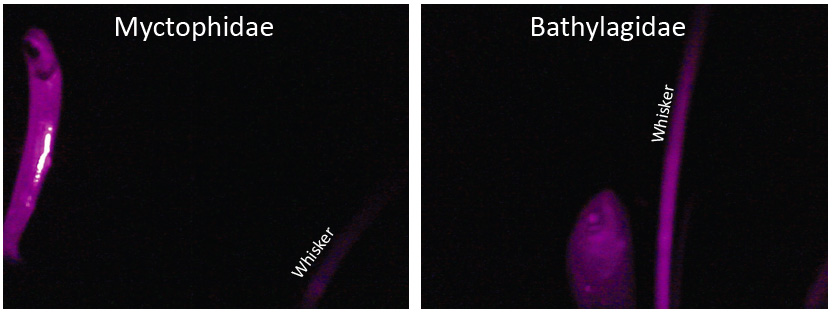
Photos of elephant seal prey!
UC Santa Cruz collaborators attached small customized infrared cameras
to the head of elephant seals and captured these images of two prey species.
These fish were captured at more than 500 meters in depth far offshore
in the northeast Pacific and represent the first glimpse of elephant seal
feeding behavior!
Click here for the full scientific paper!
Tuesday, August 20, 2013
UCSC marine mammals class visits Año Nuevo
Sunday, July 21, 2013
New Visitor Center Displays Highlight Research
We recently installed a new display at the Año Nuevo
Marine Education Center to highlight the elephant seal
research program. Below are the two presentations
currently being displayed:
Thursday, July 11, 2013
New video about mercury in elephant seals
Check out this new video highlighting the study being
conducted by Sarah Peterson, a graduate student at
UC Santa Cruz. She is studying how toxic mercury
builds up in top predators like elephant seals.
click here to see the video
conducted by Sarah Peterson, a graduate student at
UC Santa Cruz. She is studying how toxic mercury
builds up in top predators like elephant seals.
click here to see the video
Wednesday, July 3, 2013
Sunday, June 23, 2013
One of the researchers who recently worked
at Año Nuevo as part of her PhD dissertation
on elephant seal diving physiology will be an
astronaut at NASA.
Congratulations, Jessica Meir!
Click here for the full story
Click here to see her published elephant seal study
Thursday, May 23, 2013
New satellite tracking data!
We are deploying satellite tags on a new group of
adult female northern elephant seals that are about
to depart on their long post-molt migration.
Click HERE to view the latest tracking data.
(it is updated daily, so check back often!)
adult female northern elephant seals that are about
to depart on their long post-molt migration.
Click HERE to view the latest tracking data.
(it is updated daily, so check back often!)
Wednesday, May 8, 2013
Male elephant seal travels into the Bering Sea!
An adult male elephant seal was satellite-tagged earlier
this year and has now traveled all the way through the
Aleutian Islands into the Bering Sea. This is a very rare
behavior! Click this link for daily updates on
his position:
http://www.seaturtle.org/tracking/index.shtml?tag_id=56483
this year and has now traveled all the way through the
Aleutian Islands into the Bering Sea. This is a very rare
behavior! Click this link for daily updates on
his position:
http://www.seaturtle.org/tracking/index.shtml?tag_id=56483
Monday, April 29, 2013
Friday, April 26, 2013
Tuesday, April 2, 2013
ABC News Story
Ano Nuevo is getting some national media attention yet again.
Click here to read the latest story from ABC News!
ABC News - Elephant Seals Could Reveal Insights on Planet's Health (ABC News)
Click here to read the latest story from ABC News!
ABC News - Elephant Seals Could Reveal Insights on Planet's Health (ABC News)
Friday, March 29, 2013
Who’s eating all the fish?
A brief description of how Año Nuevo Island is helping salmon researchers understand fish predation:
Click Here!
Click Here!
Tuesday, February 26, 2013
Sunday, January 20, 2013
Searching for Salmon Tags
Monday, January 14, 2013
UC Santa Cruz class learns about seal research
Sunday, December 30, 2012
Sunday, December 16, 2012
Questions and Answers...
Q: Do you know what creature in the elephant
seal diet causes their poop to be orange?
A: Surprisingly, it's actually not from any prey item.
The seals don't eat much during the last week or two
of their migration, so most of the contents of the gut
are expelled before the seals even reach land. The
color is thought to be from the continual processing
of red blood cells throughout the fast. The red/orange
color is derived from the hemoglobin pigment. Each
red blood cell has a relatively short life, so they are
constantly being replenished... and elephant seals
have a LOT of red blood cells!
Monday, December 10, 2012
Tuesday, December 4, 2012
Monday, December 3, 2012
Saturday, December 1, 2012
Bill Henry's Moss Landing Marine Labs Class Field Trip
Students learn how to track an elephant seal using a VHF receiver.
Subscribe to:
Posts (Atom)