A group of researchers from The Marine Mammal Center
and UC Santa Cruz removed a plastic packing strap that
was wrapped around the neck of an elephant seal. The
strap had sliced deep into the blubber layer and would
have been fatal.
Researchers just published a study looking into the level
of human threats to marine predator populations along the
California coast. Data collected at Año Nuevo was a key
part of this analysis.
Elephant seals are being seen more often on the beaches in Canada. Click here for more info. This past molting season, biologist Paul Cottrell (Fisheries and Oceans Canada) found ~40 individuals. At least two of them (both juveniles) were carrying green flipper tags from Año Nuevo! Observations like these help scientists learn about movement and demographic patterns. UPDATE: Check out the amazing website set up by the researchers at Race Rocks... including webcams! http://www.racerocks.ca/wp/home/
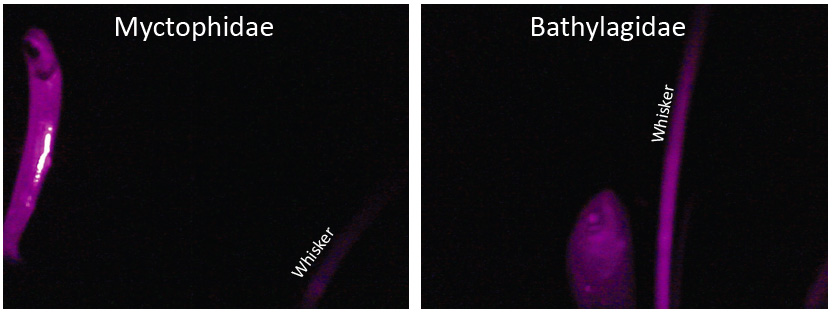
UC Santa Cruz collaborators attached small customized infrared cameras
to the head of elephant seals and captured these images of two prey species.
These fish were captured at more than 500 meters in depth far offshore
in the northeast Pacific and represent the first glimpse of elephant seal
feeding behavior!
Check out this new video highlighting the study being
conducted by Sarah Peterson, a graduate student at
UC Santa Cruz. She is studying how toxic mercury
builds
up in top predators like elephant seals.
One of the researchers who recently worked
at Año Nuevo as part of her PhD dissertation
on elephant seal diving physiology will be an
astronaut at NASA.
Congratulations, Jessica Meir!
We are deploying satellite tags on a new group of
adult female northern elephant seals that are about
to depart on their long post-molt migration.
Click HERE to view the latest tracking data.
(it is updated daily, so check back often!)
An adult male elephant seal was satellite-tagged earlier
this year and has now traveled all the way through the
Aleutian Islands into the Bering Sea. This is a very rare
behavior! Click this link for daily updates on
his position: http://www.seaturtle.org/tracking/index.shtml?tag_id=56483
Q: Do you know what creature in the elephant seal diet causes their poop to be orange? A: Surprisingly, it's actually not from any prey item. The seals don't eat much during the last week or two of their migration, so most of the contents of the gut are expelled before the seals even reach land. The color is thought to be from the continual processing of red blood cells throughout the fast. The red/orange color is derived from the hemoglobin pigment. Each red blood cell has a relatively short life, so they are constantly being replenished... and elephant seals have a LOT of red blood cells!