Dan Costa's lab at UC Santa Cruz is attaching satellite tags
and time-depth recorders to 20 adult female elephant seals
at Ano Nuevo State Park to track their movements in real-time!
Please follow this link to view the live data (updated daily).
http://www.seaturtle.org/tracking/?project_id=1000
Tuesday, June 10, 2014
Tuesday, June 3, 2014
Novel egg data loggers deployed at Ano Nuevo!
Professor Scott Shaffer and a team of researchers developed
and deployed novel egg loggers to record the nest environment and
egg-turning behavior of seabirds on Ano Nuevo Island.
Check out their new publication!
and deployed novel egg loggers to record the nest environment and
egg-turning behavior of seabirds on Ano Nuevo Island.
Check out their new publication!
Rhinoceros auklet update
Oikonos researcher Ryan Carle provides a nice summary of
the recent efforts to protect the rhinoceros auklet population
on Ano Nuevo Island.
Click here to read more!
the recent efforts to protect the rhinoceros auklet population
on Ano Nuevo Island.
Click here to read more!
Tuesday, April 29, 2014
Weanling tracking data: the first trip to sea!
UC Santa Cruz and a collaborator from CNRS in France
(Christophe Guinet) attached satellite tags to two weanling
elephant seals. Each seal was equipped with two tags (to tell
the difference between tag failure and mortality). This is the
first migration for these seals, so we are very interested to
see where they go!
Click here for the live tracking data!
(Christophe Guinet) attached satellite tags to two weanling
elephant seals. Each seal was equipped with two tags (to tell
the difference between tag failure and mortality). This is the
first migration for these seals, so we are very interested to
see where they go!
Click here for the live tracking data!
Elephant seals are important for climate change research
The elephant seal research being conducted by Dan Costa and
his team of researchers is being highlighted as an important project
for understanding the effects of climate change in our oceans.
Click here to see the full story!
his team of researchers is being highlighted as an important project
for understanding the effects of climate change in our oceans.
Click here to see the full story!
Friday, April 4, 2014
Gull foraging behavior revealed with GPS tags
Dr. Scott Shaffer, a professor at San Jose State University, and his
students have been studying the western gull population at Año Nuevo
Island. By attaching small GPS loggers to them, he can track their
movements during foraging trips. His preliminary results show that
some gulls forage at sea, but many simply head down to the Santa Cruz
Resource Recovery Facility (i.e. the dump).

students have been studying the western gull population at Año Nuevo
Island. By attaching small GPS loggers to them, he can track their
movements during foraging trips. His preliminary results show that
some gulls forage at sea, but many simply head down to the Santa Cruz
Resource Recovery Facility (i.e. the dump).

Friday, March 28, 2014
Coyotes developing a taste for fish and elephant seals!
UCSC researchers are studying the diet of the coyote population
at Año Nuevo using stable isotope analysis. They discovered that
coyotes are relying much more on marine resources, including
elephant seal carcasses, than they had in the past.
Click here for the San Jose Mercury News article.
at Año Nuevo using stable isotope analysis. They discovered that
coyotes are relying much more on marine resources, including
elephant seal carcasses, than they had in the past.
Click here for the San Jose Mercury News article.
Saturday, March 8, 2014
New paper: elephant seal pup mortality
Life his hard, especially for elephant seal pups at Año Nuevo.
Not all of the pups born here survive beyond the breeding season
and researchers are starting to investigate why. There is no single
culprit: it is a mix of blunt trauma, starvation, bite wound, drowning,
and still-births..
Click here to read the full scientific paper.
(elephant seal mother and pup, moments after birth)
Not all of the pups born here survive beyond the breeding season
and researchers are starting to investigate why. There is no single
culprit: it is a mix of blunt trauma, starvation, bite wound, drowning,
and still-births..
Click here to read the full scientific paper.
(elephant seal mother and pup, moments after birth)
Sunday, February 16, 2014
Leptospirosis study on California sea lions
Leptospirosis is a disease caused by pathogenic spirochetes and is
known to cause mortality in California sea lions (and many other animals).
Researchers from UCLA and The Marine Mammal Center are studying this
disease in sea lions at Año Nuevo Island. They have already discovered
that ~40% of sea lions are carrying Leptospira without symptoms. Their
ongoing work will help us understand the cyclic dynamics of this disease.
Click Here to read their recent scientific publication!
known to cause mortality in California sea lions (and many other animals).
Researchers from UCLA and The Marine Mammal Center are studying this
disease in sea lions at Año Nuevo Island. They have already discovered
that ~40% of sea lions are carrying Leptospira without symptoms. Their
ongoing work will help us understand the cyclic dynamics of this disease.
Click Here to read their recent scientific publication!
Thursday, February 13, 2014
Another Post-Breeding Elephant Seal Migration Begins!
Researchers in Dan Costa's lab at UC Santa Cruz are deploying
another set of tracking tags on adult female northern elephant seals.
These tags track their movements and diving behavior while the seals
are foraging far out in the north Pacific. Satellite tags allow researchers
to track the seals in real-time. Please follow the link below to view
the live data!

http://www.seaturtle.org/tracking/?project_id=971
another set of tracking tags on adult female northern elephant seals.
These tags track their movements and diving behavior while the seals
are foraging far out in the north Pacific. Satellite tags allow researchers
to track the seals in real-time. Please follow the link below to view
the live data!
http://www.seaturtle.org/tracking/?project_id=971
Thursday, January 16, 2014
Año Nuevo seals visit other colonies
Elephant seals from Año Nuevo occasionally visit other colonies.
This season, several of the seals carrying satellite tags are heading
south to either Piedras Blancas or the Channel Islands.
Click here to view the live tracking data to see when and where
the rest of the seals decide to haul out and give birth!
This season, several of the seals carrying satellite tags are heading
south to either Piedras Blancas or the Channel Islands.
Click here to view the live tracking data to see when and where
the rest of the seals decide to haul out and give birth!
Elephant seal research helps ocean conservation
Dan Costa's team at UC Santa Cruz has been studying elephant seals
at Año Nuevo and have helped to develop and test the latest
technologies that are used to help conservation efforts around the world.
This recent article on the National Geographic website highlights the
importance of technology in ocean conservation and focuses on
a recent scientific paper written by Dan Costa.
Saturday, December 7, 2013
Live Science article highlights graduate student research
Caroline Casey, a graduate student in Dr. Colleen Reichmuth's lab
at UC Santa Cruz, was featured in a recent Live Science article
based on her talk at a recent scientific meeting. She is studying
threat call communication between big adult male seals.
Click here for the full article!
Click here to visit the Reichmuth lab website!
at UC Santa Cruz, was featured in a recent Live Science article
based on her talk at a recent scientific meeting. She is studying
threat call communication between big adult male seals.
Click here for the full article!
Click here to visit the Reichmuth lab website!
Wednesday, November 20, 2013
290 Scientific publications from Año Nuevo!
Researchers working at Año Nuevo are producing a
remarkable number of peer-reviewed publications: nearly
300 in total dating back to the 1920's (and 17 so far this year!)
Thursday, October 31, 2013
Entangled seal is rescued!
Tuesday, October 29, 2013
New study shows human impacts on marine predators
Researchers just published a study looking into the level
of human threats to marine predator populations along the
California coast. Data collected at Año Nuevo was a key
part of this analysis.
Read the Santa Cruz Sentinel article
of human threats to marine predator populations along the
California coast. Data collected at Año Nuevo was a key
part of this analysis.
Read the Santa Cruz Sentinel article
Sunday, September 15, 2013
Island webcam is working!
The webcam located on Año Nuevo Island has been
fixed and is now streaming a live view of the island.
Check back throughout the year to see all of the various
species of marine mammals and birds!
Click Here for the video stream
Explore a 3D elephant seal track!
Would you like a chance to explore a three-dimensional
elephant seal track using google earth?
Download this google earth KMZ file:
To view this track, first be sure you have "google earth"
installed on your computer. (it is available for free online).
If you would like assistance navigating within google earth
please watch this video:
http://www.youtube.com/watch?
Click Here to read a scientific paper about elephant seals
foraging on seamounts.
Monday, September 2, 2013
Juvenile gray whale spends a month at Año Nuevo
Saturday, August 31, 2013
Año Nuevo seals in Canada!
Elephant seals are being seen more often on the
beaches in Canada. Click here for more info.
This past molting season, biologist Paul Cottrell
(Fisheries and Oceans Canada) found ~40 individuals.
At least two of them (both juveniles) were carrying
green flipper tags from Año Nuevo! Observations like
these help scientists learn about movement and
demographic patterns.
UPDATE: Check out the amazing website set up by the
researchers at Race Rocks... including webcams!
http://www.racerocks.ca/wp/home/

beaches in Canada. Click here for more info.
This past molting season, biologist Paul Cottrell
(Fisheries and Oceans Canada) found ~40 individuals.
At least two of them (both juveniles) were carrying
green flipper tags from Año Nuevo! Observations like
these help scientists learn about movement and
demographic patterns.
UPDATE: Check out the amazing website set up by the
researchers at Race Rocks... including webcams!
http://www.racerocks.ca/wp/home/

Tuesday, August 27, 2013
Photos of elephant seal prey!
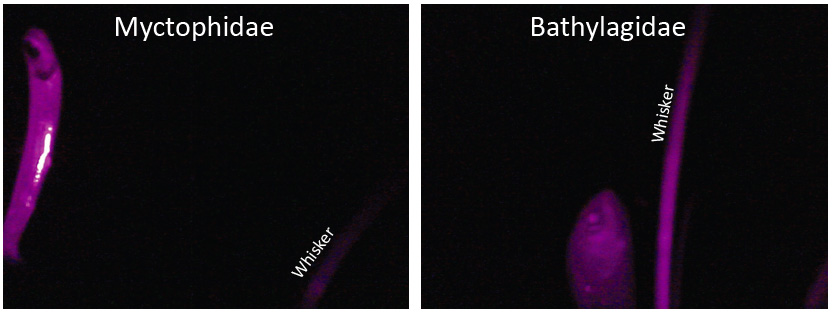
UC Santa Cruz collaborators attached small customized infrared cameras
to the head of elephant seals and captured these images of two prey species.
These fish were captured at more than 500 meters in depth far offshore
in the northeast Pacific and represent the first glimpse of elephant seal
feeding behavior!
Click here for the full scientific paper!
Tuesday, August 20, 2013
UCSC marine mammals class visits Año Nuevo
Sunday, July 21, 2013
New Visitor Center Displays Highlight Research
We recently installed a new display at the Año Nuevo
Marine Education Center to highlight the elephant seal
research program. Below are the two presentations
currently being displayed:
Thursday, July 11, 2013
New video about mercury in elephant seals
Check out this new video highlighting the study being
conducted by Sarah Peterson, a graduate student at
UC Santa Cruz. She is studying how toxic mercury
builds up in top predators like elephant seals.
click here to see the video
conducted by Sarah Peterson, a graduate student at
UC Santa Cruz. She is studying how toxic mercury
builds up in top predators like elephant seals.
click here to see the video
Wednesday, July 3, 2013
Sunday, June 23, 2013
One of the researchers who recently worked
at Año Nuevo as part of her PhD dissertation
on elephant seal diving physiology will be an
astronaut at NASA.
Congratulations, Jessica Meir!
Click here for the full story
Click here to see her published elephant seal study
Thursday, May 23, 2013
New satellite tracking data!
We are deploying satellite tags on a new group of
adult female northern elephant seals that are about
to depart on their long post-molt migration.
Click HERE to view the latest tracking data.
(it is updated daily, so check back often!)
adult female northern elephant seals that are about
to depart on their long post-molt migration.
Click HERE to view the latest tracking data.
(it is updated daily, so check back often!)
Wednesday, May 8, 2013
Male elephant seal travels into the Bering Sea!
An adult male elephant seal was satellite-tagged earlier
this year and has now traveled all the way through the
Aleutian Islands into the Bering Sea. This is a very rare
behavior! Click this link for daily updates on
his position:
http://www.seaturtle.org/tracking/index.shtml?tag_id=56483
this year and has now traveled all the way through the
Aleutian Islands into the Bering Sea. This is a very rare
behavior! Click this link for daily updates on
his position:
http://www.seaturtle.org/tracking/index.shtml?tag_id=56483
Monday, April 29, 2013
Friday, April 26, 2013
Tuesday, April 2, 2013
ABC News Story
Ano Nuevo is getting some national media attention yet again.
Click here to read the latest story from ABC News!
ABC News - Elephant Seals Could Reveal Insights on Planet's Health (ABC News)
Click here to read the latest story from ABC News!
ABC News - Elephant Seals Could Reveal Insights on Planet's Health (ABC News)
Friday, March 29, 2013
Who’s eating all the fish?
A brief description of how Año Nuevo Island is helping salmon researchers understand fish predation:
Click Here!
Click Here!
Tuesday, February 26, 2013
Sunday, January 20, 2013
Searching for Salmon Tags
Monday, January 14, 2013
UC Santa Cruz class learns about seal research
Sunday, December 30, 2012
Sunday, December 16, 2012
Questions and Answers...
Q: Do you know what creature in the elephant
seal diet causes their poop to be orange?
A: Surprisingly, it's actually not from any prey item.
The seals don't eat much during the last week or two
of their migration, so most of the contents of the gut
are expelled before the seals even reach land. The
color is thought to be from the continual processing
of red blood cells throughout the fast. The red/orange
color is derived from the hemoglobin pigment. Each
red blood cell has a relatively short life, so they are
constantly being replenished... and elephant seals
have a LOT of red blood cells!
seal diet causes their poop to be orange?
A: Surprisingly, it's actually not from any prey item.
The seals don't eat much during the last week or two
of their migration, so most of the contents of the gut
are expelled before the seals even reach land. The
color is thought to be from the continual processing
of red blood cells throughout the fast. The red/orange
color is derived from the hemoglobin pigment. Each
red blood cell has a relatively short life, so they are
constantly being replenished... and elephant seals
have a LOT of red blood cells!
Monday, December 10, 2012
Tuesday, December 4, 2012
Monday, December 3, 2012
Saturday, December 1, 2012
Bill Henry's Moss Landing Marine Labs Class Field Trip
Students learn how to track an elephant seal using a VHF receiver.
Subscribe to:
Posts (Atom)